What is CTV Advertising?
 |
Pathlabs Marketing |
 |
March 20, 2026 |
In 2025, streaming captured roughly 45% of total TV usage and surpassed broadcast and cable combined for the first time.
That milestone reflects a structural reallocation of brand dollars to Connected TV (CTV) environments, which operate differently from linear television. Most notably, it is widely accessible at scale, and CTV measurement mechanics underneath that access are layered, fragmented, and unevenly transparent.
Independent agencies that treat CTV like digital TV often encounter cost leakage, reporting gaps, and frequency inefficiencies. Agencies that approach it as a governed performance channel build a durable operational advantage.
What Is Connected TV (CTV) Advertising?
CTV advertising is defined by the device itself. The ad runs on an internet-connected television, meaning viewers experience it on the largest screen in the home rather than on a mobile device or desktop.
What changes is how those ads are bought and delivered. Budgets that once moved directly through TV networks now flow through digital buying systems.
That structure blends television-level expectations for reach and creative quality with digital-style buying mechanics. However, those added layers can increase cost variation, create repeated household exposure, and complicate reporting unless execution is tightly managed.
How Is Connected TV Different From OTT?
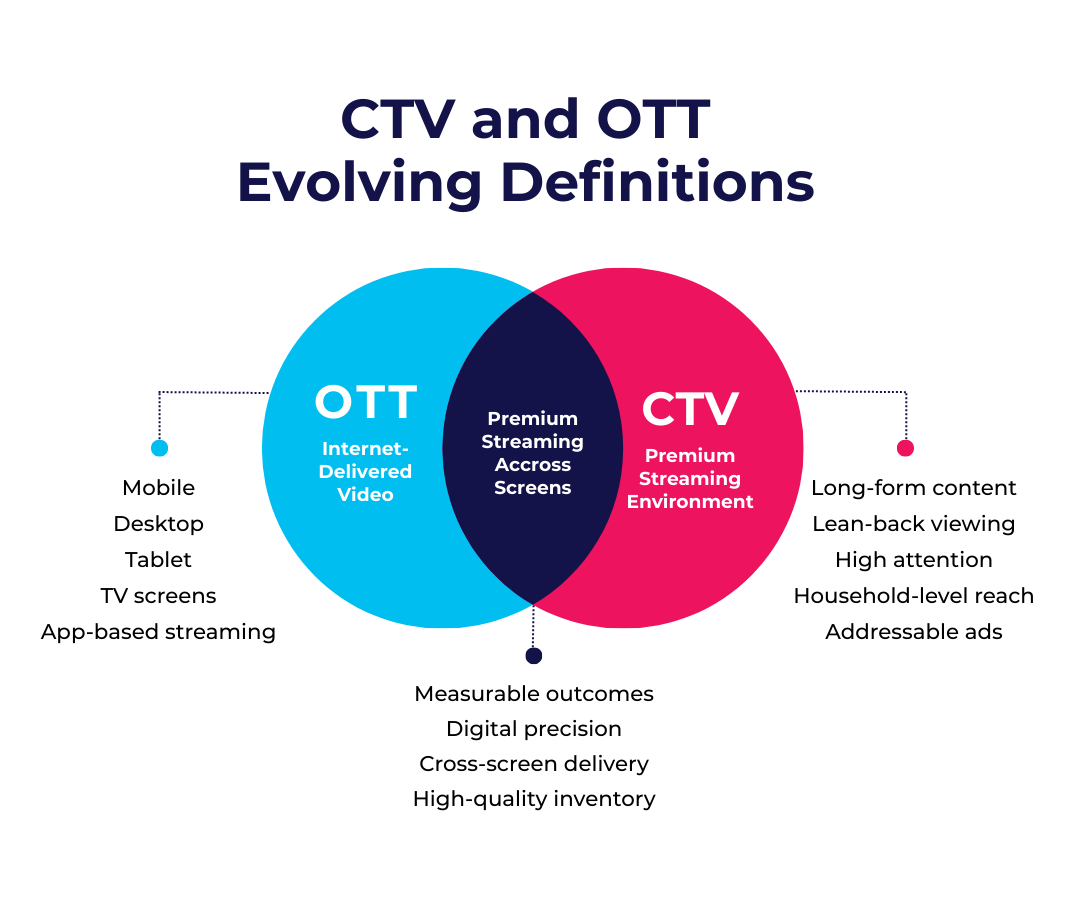
In the simplest terms, CTV advertising is when advertisers reach their audience through an internet-Connected TV, originally referred to as devices used to stream content on a television screen, while OTT refers to internet-delivered video accessible across mobile, desktop, tablet, and CTV environments.
Today, the distinction holds less operational weight. CTV has come to represent premium, long-form streaming environments associated with lean-back viewing and close attention, regardless of screen.
Why Is CTV Inventory Expanding So Quickly?
Inventory growth is being driven primarily by ad-supported subscription tiers and free ad-supported streaming channels.
Industry reporting indicates that nearly half of U.S. streaming subscribers are now on ad-supported plans, and most new subscriptions over the past several quarters have selected ad-supported options.
More ad-supported viewing creates incremental impressions. Those impressions enter the market through direct IOs, curated marketplaces, open exchange pipes, and device-level integrations.
Which Connected TV Advertising Platforms Matter, and How Should You Buy Them?
CTV buying generally falls into three categories: direct publisher relationships, device or operating system ecosystems, and programmatic platforms aggregating supply.
The operational question centers on how many distinct supply paths are introduced into a plan and whether each path is justified.
The same impression can be accessible through multiple intermediaries. Without supply path discipline, agencies risk paying different effective CPMs for comparable inventory.
How Pricing Varies Across Access Points
Premium streaming CPMs typically range from the low-$30s to the low-$40s, depending on platform, audience, and buying structure, as reflected in recent buyer commentary on premium streaming pricing.
That range can widen materially based on access route and fees. Agencies managing CTV at scale should formalize platform inclusion criteria, including transparent fee structures, app-level reporting, identity signal quality, and household frequency capabilities, where available.
For agencies that lack internal buying infrastructure, this is where Pathlabs’ Media Execution Partnership (MEP) model fits most naturally: it centralizes supply path selection, enforces transparent fee structures, and standardizes QA and reporting across connected TV advertising platforms, so governance is embedded before spend scales.
Targeting That Actually Holds Up in CTV
Reliable CTV targeting centers on first-party audiences, contextual alignment, geographic controls, and sequenced messaging. These approaches align with how households consume streaming content and how identity is structured in most environments.
Deterministic vs. Modeled Identity Signals
Logged-in ecosystems operate on deterministic user data. Open programmatic environments often rely on modeled or probabilistic household graphs.
Agencies should map where deterministic matching applies and where modeling introduces margin of error, then set performance expectations accordingly.
Targeting precision does not eliminate overlap. As campaigns extend across multiple buying environments, household duplication can increase. Where technical controls allow, household-level frequency caps should be enforced. Where they do not, agencies should implement overlap analysis through measurement partners or structured testing frameworks.
How Should Agencies Approach Measurement in CTV?
CTV measurement requires separating verified exposure from modeled impact. Reach, frequency, and completion rates provide delivery truth. Business impact should be evaluated through incrementality frameworks such as lift studies, geo-based experiments, matched market testing, or transparent modeled analysis.
Digital video now comprises the majority share of total TV and video ad spend. That scale increases pressure to demonstrate performance. No single platform observes every exposure across environments. Cross-platform deterministic attribution requires careful review of methodology and data scope.
Agencies should define measurement architecture before launch:
Primary objective aligned to business outcome.
Standardized reach and frequency reporting.
Documented incrementality methodology.
Reconciliation rules between platform and third-party reporting.
Measurement discipline reduces interpretation risk and clarifies assumptions.
What a High-Performance CTV Strategy Looks Like for Agencies
A disciplined CTV strategy defines the channel’s role within the broader media mix and enforces operational standards before scaling spend.
Key components include:
Consolidated, vetted supply paths.
Clear platform selection standards.
Household frequency controls.
Cross-platform reporting reconciliation processes.
Incrementality-first measurement frameworks.
The MEP model formalizes these controls by centralizing buying governance, QA standards, and reporting consistency across connected TV advertising platforms.
The objective is operational stability and measurable performance. In practice, this means agencies retain strategic ownership while execution standards, reporting logic, and cost controls are applied consistently across every CTV campaign.
Operational Discipline Is the Real Competitive Advantage in Connected TV
Connected TV is a scaled, primary video channel commanding a substantial share of total viewing and more than $30 billion in annual U.S. ad investment.
Agencies that consolidate supply paths, enforce transparent reporting, manage household frequency, and ground performance evaluation in incrementality generate more consistent outcomes.
For independent agencies, Pathlabs’ Media Execution Partnership provides that infrastructure layer, aligning strategy, buying execution, and measurement standards so CTV scale translates into accountable performance rather than operational drag.
Frequently Asked Questions About CTV Advertising
How Do You Measure CTV?
You measure CTV by separating delivery metrics from outcome metrics.
Delivery measurement includes impressions, reach, frequency, video completion rate, and cost efficiency. Outcome measurement should rely on incrementality frameworks such as lift studies, geo tests, matched-market analysis, or carefully documented attribution models rather than platform claims alone.
What’s The Difference Between CTV and OTT?
CTV refers to the internet-connected television screen or viewing environment, while OTT refers to the delivery of video content over the internet across screens.
In practice, CTV usually describes premium streaming inventory viewed on the TV screen, while OTT remains the broader distribution category that can include mobile, desktop, tablet, and connected television.
What Are CTV Platforms?
CTV platforms are the environments and tools advertisers use to access streaming inventory. That includes publisher apps and services, device and operating system ecosystems, and buying platforms such as DSPs that aggregate supply.